H is For Haiku is the lovely result of the imaginative, creative, and lyrical work of Sydell Rosenberg, mother of Amy Losak.
In honor of her mother, Amy Losak pursued the publication of her mother’s Haiku. Syd, one of the first members of the Haiku Society of America, dreamed of publishing a book for children focused on Haiku.
Haiku, a form of poetry, originated in Japan. Most readers recognize Haiku for the strict syllable count used for each of the three lines (most often 5-7-5) in a Haiku poem. Haiku is way to recognize the small things of nature and life-wonderful, amazing, poetic, and awe-inspiring.
“What’s most important about writing haiku is to focus on those many small moments we may overlook and make them special.” -Amy Losak
Beautifully illustrated, H is For Haiku brought a smile to my face with every new alphabet letter and corresponding Haiku. I enjoyed clever phrases, rich language, and observations of the natural life around us.
Well done, Sydell Rosenberg! Great job, Sawsan Chalabi! Amy Losak, I’m so glad you stuck with it and had H is For Haiku published. This book is a gift for us, if we but take the time to read and ponder.
KID KANDY:
Write Your Own Haiku Poem
1. Read H is for Haiku. Notice the clever words and illustrations. Both help tell the story of the Haiku.
2. Take a notepad and pencil outside. Spend time observing the nature around you. Focus on the small things you see. As you look, write down words that come to your mind. A parent or older sibling can help with this part.
3. Do you know what a syllable is? Clap your name. For me, I clap twice: An gie. 2 syllables. Practice with some other words.
4. Haiku is a poem with 3 lines. Each line has a certain syllable count: 5-7-5
5. Some people are not very strict with keeping the exact syllable counts, but it’s good practice as you learn the format for a Haiku poem.
6. Choose something you observed to be the subject of your Haiku. What do you want to say? Write down the words you want to use. Play with the words. Count out syllables. You can write ANYTHING you want in your Haiku poem.
7. Print your Haiku poem on clean paper. Add an illustration! Share it with a friend or family member! OR ME!!!
I won a copy of Nature’s Lullaby Fills the Night from KIDLIT411. Thanks, Sylvia and Elaine!
Nature’s Lullaby Fills the Night is the perfect bedtime – or anytime – read aloud! Peaceful rhyme tells the story of nature getting ready to go to sleep. Animals, plants, and other beauties prepare and nestle in for a good nights’ sleep. The illustrations, set in gorgeous deep blues and purples highlighted by nighttime light, perfectly match the winding down of the day.
I’ve totally enjoyed reading Nature’s Lullaby Fills the Night. Now, on to share it with the littles in my life. Thanks for the beautiful book, Dee and Bali!
KID KANDY:
Nighttime Painting
Materials: watercolor paints, brushes, water, crayons, heavy paper
1. Read Nature’s Lullaby Fills the Night. Notice the colors used in the illustrations. What’s your favorite page (animal, plant, setting)?
2. Use crayons to draw a nature picture. Include the moon and stars.
3. Paint over the drawing with darker colors like purple, blue, and black.
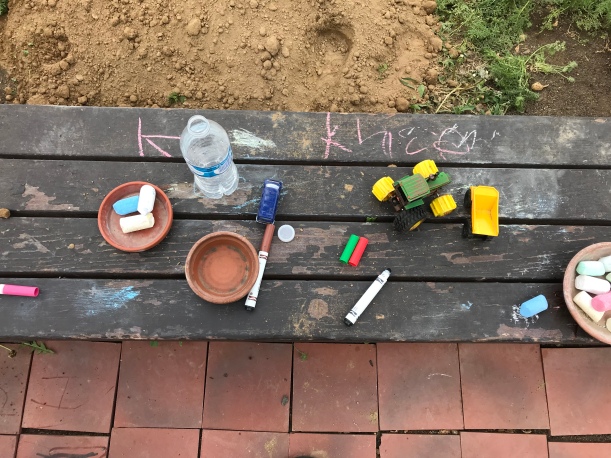
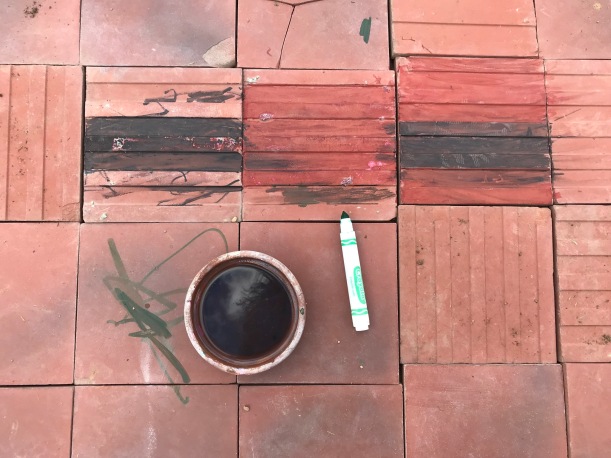
Dried-up markers make excellent painting tools when dipped in clay saucers of water?
Water color makers make pretty cool paintings on the clay tiles of a patio.
Chalk is another fun tool. Water, chalk, clay tiles. That’s it.
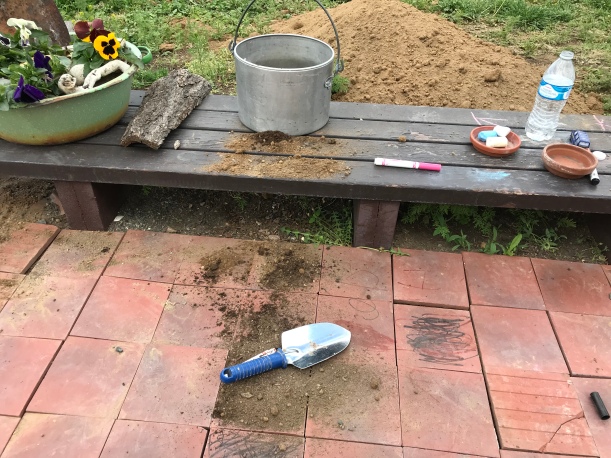
Dirt. Always fun. Anyplace. Dig out the gardening tools and construction toys.
Wood benches also make the perfect canvas for dried-up markers and water and chalk and water.
River rocks, those flat, smooth sorts that are so awesome to hold and touch, make wonderful stacking blocks. Add them to clay saucers to experiment with how they change colors. And paint them with chalk and markers.
Add some off-roading or construction vehicles for a different type of exploration.
Turn the tiles over. Bumpy road! (My tiles have ridges on the back.)
Cut fallen branches into logs for building. Birch trees are a personal favorite. My kiddos love peeling the paper off (extra fine motor practice) and I can use it for crafts. Or they can.
All of the above? Leave as is and let the rain or sprinkler wash away the traces. Or spritz the clay tiles and benches with water and TA-DA, clean, fresh canvases for more fun!
So go ahead, enjoy those dried-up markers, clay tiles, rocks, branches, and benches. I love watching my grands explore, create, make a mess, and explore. Me? Not a care in the world since it all washes off.
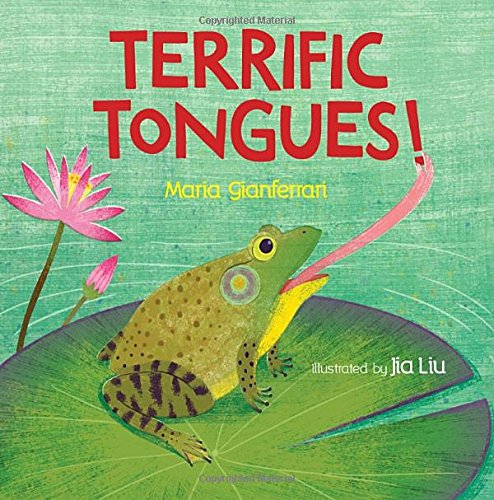
Vivian Kirkfield recently shared a great post about this wonderful book, TerrificTongues! Written by Maria Gianferrari and illustrated by Jia Liu, Terrific Tongues! is sure to engage, amuse, and educate young readers.
I mean, really, what child do you know who doesn’t love playing with or sticking out his or her tongue? I can’t wait get my hands on this one. Thanks, Vivian, Maria, and Jia! Congratulations!
Click here to visit Vivian Kirkfield’s blog and read more about Terrific Tongues!
Grandmother Thorn gives new meaning to the words OCD (obsessive compulsive disorder). She maintains her gardens with an iron will, daring anything to be out of place, grow where it’s not supposed to, or become mussed by irresponsible footprints.
Only one friend, Ojiisan, the man with a dragging foot and droopy shoulder, was allowed to make tracks in her perfectly groomed gravel paths. For they were best friends and enjoyed hot tea, conversation, and tasty sweets.
All was well until one day Ojiisan tasted gorgeous red berries and urged the salesperson to take some to Grandmother Thorn (but DO NOT walk on the path).
As you can imagine, he did not listen and disaster befell the merchant, the garden, and the welfare of Grandmother Thorn.
Or did it?
This beautiful picture book shares the story of letting go and allowing some things to be. And not all weeds are what they appear.
I love this book, both for the story and the tapestry-like illustrations.
KID KANDY:
Berry Hunt
1. Read GRANDMOTHER THORN. Memorize all the details you can of the weed and its fruit.
2. Does anyone in your family go grocery shopping or visit a farmer’s market? It’s time to go with that person. Go shopping.
3. Search the produce section. Can you find the fruit found in GRANDMOTHER THORN? Maybe your adult shopper will buy some!
4. Perhaps you live in an area where this type of fruit grows. Look around your neighborhood and see if you find the vines. If you time it right, you might even be able to pick some of those tasty fruits!
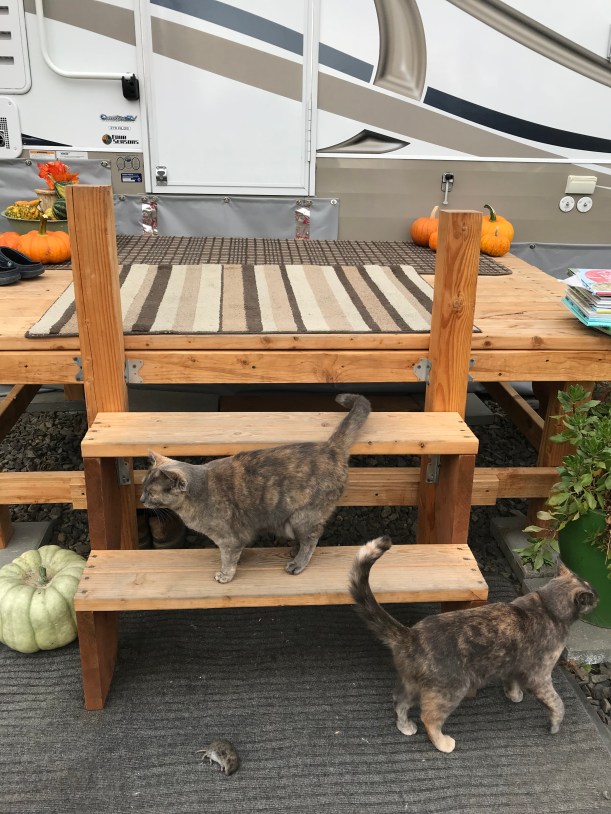
Just before Christmas, our family was devastated to discover neighborhood dogs had destroyed our precious love-love (my nickname for her) Mabel. It was pretty awful. We still miss our little gray girl every day.
No more “Which one is this?” from the grands (and everyone else). No more help working on my writing projects. No more kitty tracks on my printed papers. No more head butts and lap cuddles.
Monet, her twin sister, was lost for quite a few weeks and is now just finally starting to come into her own as an ONLY cat. There are times she quite enjoys the attention. The rest of the time she’d rather be out mousing or birding. She was always the more independent wild thing.
To combat future attacks, we put up a gate on our driveway to discourage any other dogs from wandering in to check out what trouble they could get into. As Papa and Hayden finished up the gate, they decided it should be named after Mabel, a tribute to her short, cuddly, furry life.
Perfect! In honor of our Mabes, Mabel, love-love, gray girl, kitty baby. The MABEL gate. Ta-da!
Ooh, making lists of things we are curious about and things that capture our imagination and things we love! This is the perfect way to fly deep and dig up ideas for picture books!
Technique does conquer all! It’s not speed, size, or strength that helps us discover ideas or write well. It’s the technique, or craft, that helps us reach our goals of dreaming up and listing ideas – and then turning those golden ideas into projects.
In this blog post, Tim lists some techniques writers might use to brainstorm. He has some new ideas I want to try. But what popped into my mind was how I stare into space. It seems that helps me come up with new ideas. I also get ideas when I am outside in the mountains or going for a walk in my neighborhood. Now I just need to make sure to write down those thoughts.