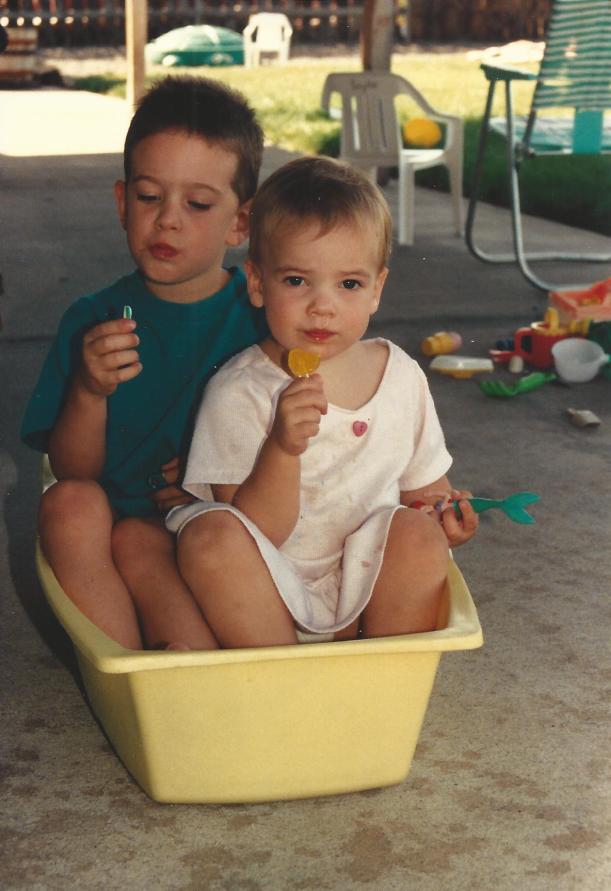
Taylor and Chelsie enjoy a sticky treat while lounging in a plastic baby bathtub.
A tub can be . . .
Actually, a child’s plastic bathtub can be:
a snacking spot
a boat
a water table
a push car
a chair
a sink for washing
an actual bathtub
a container for small animals
a storage unit
a reading nook
a garden box
an art project
a doll bed
a watering tub (for animals or kids)
a pond
a fairy garden
a mud pie factory
sand box
a cat box (if one is not careful)
Taylor and Chelsie (circa @1992) are enjoying some good old sticky lollipops as they sit in the baby bathtub. It was no longer a bathtub at this point, but instead became the object of many imaginative games.
How about you? What other uses have you found for a plastic baby bathtub?
The Hill kids, Mark (blue suit), me (tallest), Tracy (white knee socks), and James (bib), next to the family roadster!
Station wagons and me, we go way back.
In the late 80s, my husband accepted employment with a new company, one benefit being a company car. “Anything would be cool, but please don’t come home with a station wagon. And especially not one with fake wood details.”
Ahem. Yes. He came with a station wagon. Adornment of imitation wood panels? Whew. Dodged that faux grained bullet.
Even earlier than the 80s & 90s version of the station wagon work vehicle was the early 70s family models owned by my parents. We had at least 2 different family touring vehicles, blue and white. Those wagons could really hold people and belongings. And pets, groceries, camping equipment, children, toys. Nothing like the little trunks in modern cars.
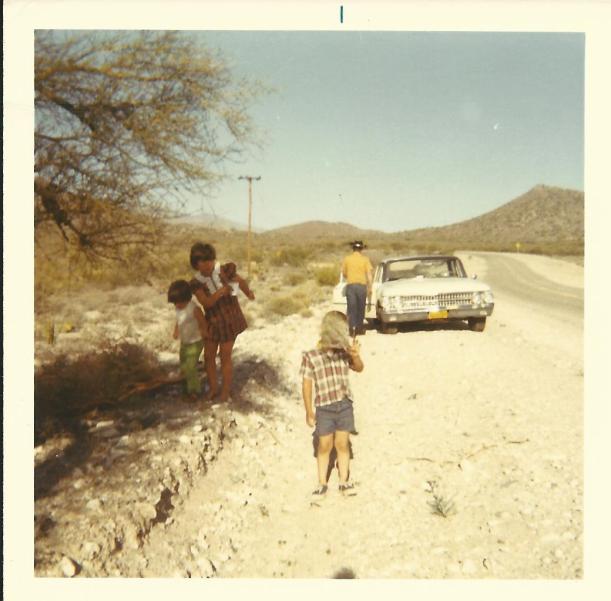
The family station wagon, mid-trip exploring the Arizona desert.
Some of my fondest memories are the days we spent exploring the southwest. We’d load up 2 parents, 4 kids, and 1 collie dog. The first mandatory stop would be a mini-mart so we could purchase the required bologna, cheese, white bread, and soda for our snacking pleasure. Sometimes we ate hot dogs (always cold) instead of bologna, but either one was a treat. Then we would hit the road.
The Arizona desert is a wondrous place for questing. Forests, rivers, desert lands, mountains, ghost towns, dirt roads, historical sites. My parents loved to haul us around seeing what we could see. I have vivid pictures in my mind of those trips, but I can’t help but wonder if we didn’t drive mom and dad the slightest bit crazy. 4 kids and a dog in a station wagon? Even if we did use the fold-up seats in the way back to separate us.
Horned toads, tarantulas, snakes, spiders, scorpions, cacti, sagebrush, thorns, stickers, heat mirages, dust. Treasure is all in the eyes and heart of the explorer.
What about you? What memories do you have about a vehicle or early days with your family? I’d love to hear your tales on this #ThrowbackThursday.
We ‘hiked’ the trail at Selah Cliffs Natural Area Preserves on Saturday.
Where: Seven miles north of Selah, just south of mile post 3 on SR 821, or as locals know it, the Yakima Canyon Road (slightly northeast of Selah)
Distance: RT about 2.5 miles, if you go all the way to the cattle guard and fence that signals the Military Firing Center boundaries
Discovery Pass Required: Yes, though many parked beyond the nature preserve lot on the old canyon road
Tips: No toilet facilities and not much shade; Bring binoculars, bug spray, water, and hat
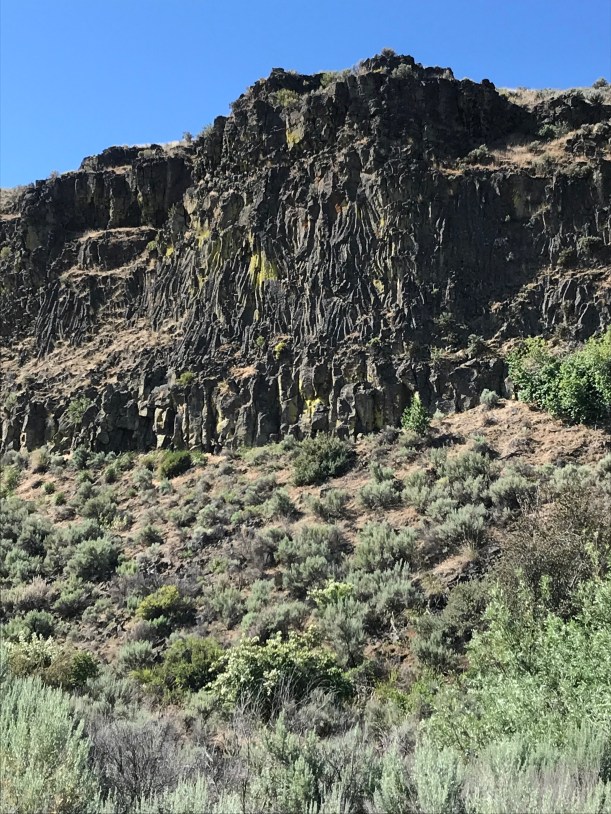
This is a local, easy hike with the hardest parts being concern for ticks, rattlesnakes, and heat. The views of the Selah Cliffs are gorgeous. As per signed instructions, we didn’t traipse off the path, which means we also didn’t see the basalt daisies for which the area is known. Judging by the trails leading up to the basalt cliffs, I’m sure some disregard rules. OR they could be game trails. Yes, I’ll go with that.
The hike/walk leads along a gravelled path for most of the distance. Towards the far end (headed east), hikers must go through a barbed-wire gate. After that, the gravel disappears and more clambering is required. During the entire hike east, we watched the Fred G. Redmon bridge loom ever larger and closer. Soon enough, we stood beneath the massive structure and listened to vehicles boom overhead. It was fascinating to look, listen, and call aloud. If you stand in just the right spot, your voice will echo back. I tried recording the echo, but there was too much interference.
We saw and heard a waterfall, but couldn’t get through the underbrush to get close. Plentiful birds, spiders, insects, lizards, and evidence of other wildlife kept us searching and entertained. The scenery was gorgeous, the basalt columns beautiful, and amazingly, the traffic overhead was negligible.
H is For Haiku is the lovely result of the imaginative, creative, and lyrical work of Sydell Rosenberg, mother of Amy Losak.
In honor of her mother, Amy Losak pursued the publication of her mother’s Haiku. Syd, one of the first members of the Haiku Society of America, dreamed of publishing a book for children focused on Haiku.
Haiku, a form of poetry, originated in Japan. Most readers recognize Haiku for the strict syllable count used for each of the three lines (most often 5-7-5) in a Haiku poem. Haiku is way to recognize the small things of nature and life-wonderful, amazing, poetic, and awe-inspiring.
“What’s most important about writing haiku is to focus on those many small moments we may overlook and make them special.” -Amy Losak
Beautifully illustrated, H is For Haiku brought a smile to my face with every new alphabet letter and corresponding Haiku. I enjoyed clever phrases, rich language, and observations of the natural life around us.
Well done, Sydell Rosenberg! Great job, Sawsan Chalabi! Amy Losak, I’m so glad you stuck with it and had H is For Haiku published. This book is a gift for us, if we but take the time to read and ponder.
KID KANDY:
Write Your Own Haiku Poem
1. Read H is for Haiku. Notice the clever words and illustrations. Both help tell the story of the Haiku.
2. Take a notepad and pencil outside. Spend time observing the nature around you. Focus on the small things you see. As you look, write down words that come to your mind. A parent or older sibling can help with this part.
3. Do you know what a syllable is? Clap your name. For me, I clap twice: An gie. 2 syllables. Practice with some other words.
4. Haiku is a poem with 3 lines. Each line has a certain syllable count: 5-7-5
5. Some people are not very strict with keeping the exact syllable counts, but it’s good practice as you learn the format for a Haiku poem.
6. Choose something you observed to be the subject of your Haiku. What do you want to say? Write down the words you want to use. Play with the words. Count out syllables. You can write ANYTHING you want in your Haiku poem.
7. Print your Haiku poem on clean paper. Add an illustration! Share it with a friend or family member! OR ME!!!
I won a copy of Nature’s Lullaby Fills the Night from KIDLIT411. Thanks, Sylvia and Elaine!
Nature’s Lullaby Fills the Night is the perfect bedtime – or anytime – read aloud! Peaceful rhyme tells the story of nature getting ready to go to sleep. Animals, plants, and other beauties prepare and nestle in for a good nights’ sleep. The illustrations, set in gorgeous deep blues and purples highlighted by nighttime light, perfectly match the winding down of the day.
I’ve totally enjoyed reading Nature’s Lullaby Fills the Night. Now, on to share it with the littles in my life. Thanks for the beautiful book, Dee and Bali!
KID KANDY:
Nighttime Painting
Materials: watercolor paints, brushes, water, crayons, heavy paper
1. Read Nature’s Lullaby Fills the Night. Notice the colors used in the illustrations. What’s your favorite page (animal, plant, setting)?
2. Use crayons to draw a nature picture. Include the moon and stars.
3. Paint over the drawing with darker colors like purple, blue, and black.
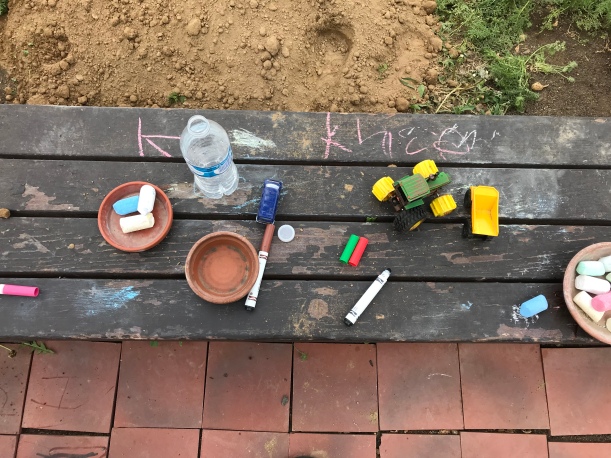
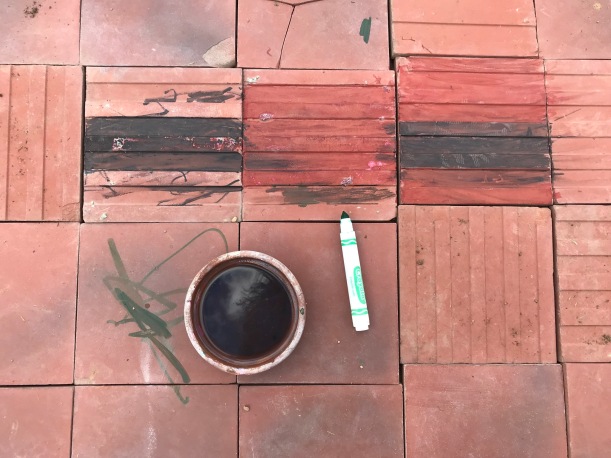
Dried-up markers make excellent painting tools when dipped in clay saucers of water?
Water color makers make pretty cool paintings on the clay tiles of a patio.
Chalk is another fun tool. Water, chalk, clay tiles. That’s it.
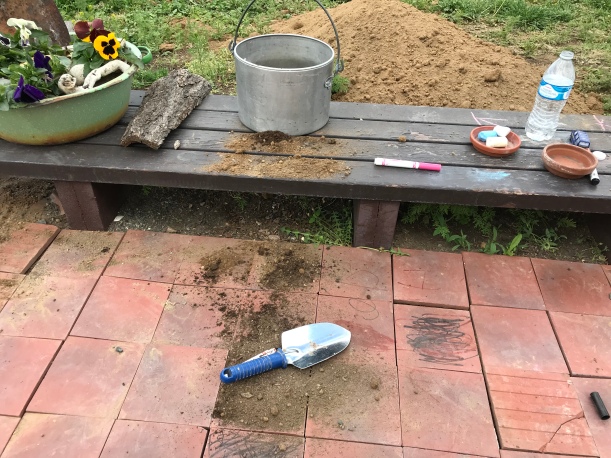
Dirt. Always fun. Anyplace. Dig out the gardening tools and construction toys.
Wood benches also make the perfect canvas for dried-up markers and water and chalk and water.
River rocks, those flat, smooth sorts that are so awesome to hold and touch, make wonderful stacking blocks. Add them to clay saucers to experiment with how they change colors. And paint them with chalk and markers.
Add some off-roading or construction vehicles for a different type of exploration.
Turn the tiles over. Bumpy road! (My tiles have ridges on the back.)
Cut fallen branches into logs for building. Birch trees are a personal favorite. My kiddos love peeling the paper off (extra fine motor practice) and I can use it for crafts. Or they can.
All of the above? Leave as is and let the rain or sprinkler wash away the traces. Or spritz the clay tiles and benches with water and TA-DA, clean, fresh canvases for more fun!
So go ahead, enjoy those dried-up markers, clay tiles, rocks, branches, and benches. I love watching my grands explore, create, make a mess, and explore. Me? Not a care in the world since it all washes off.
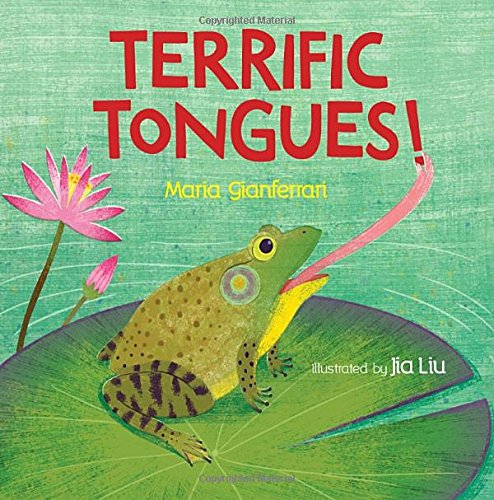
Vivian Kirkfield recently shared a great post about this wonderful book, TerrificTongues! Written by Maria Gianferrari and illustrated by Jia Liu, Terrific Tongues! is sure to engage, amuse, and educate young readers.
I mean, really, what child do you know who doesn’t love playing with or sticking out his or her tongue? I can’t wait get my hands on this one. Thanks, Vivian, Maria, and Jia! Congratulations!
Click here to visit Vivian Kirkfield’s blog and read more about Terrific Tongues!








 Love, Laughter, and Life