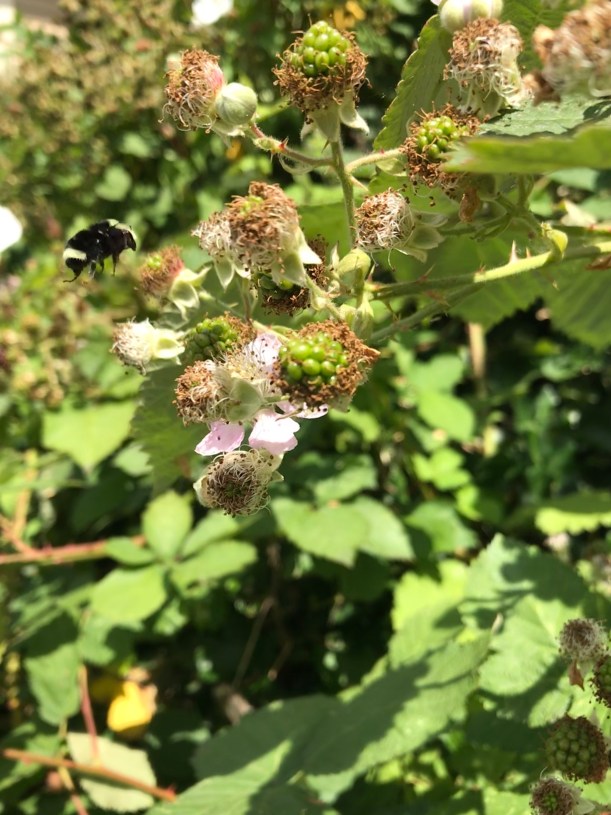
A hectic summer schedule has provided ample time for weeds to take over the garden.
Despite some attempts at control, a busy travel itinerary leaves much to be desired in the ‘finding edible items in the garden’ category. Is everything growing? Yes! All experiments and plant combinations are thriving with unbridled passion.
But alas, the weeds have accepted the challenge and are rising to the top, willy-nilly.
Enter gardening goal: Fill to overflowing one wheelbarrow full of weeds each day I am home. At this rate, the garden will look spectacular by October 1.
Gardening gone bad, you lose!
Until then, we play garden hide-and-seek for prized veg and fruit.
One can’t be all work and no play, especially on a writing retreat.
First, there is the cat. Cosmo is quite happy to give me as many breaks a day as I can handle (and then some). Plus he delivers wrap-his-paws-around-my-neck loves, a warm kitty neck warmer, and blankets of kitty fur.
Then there are the windows. Such delightful windows, with a garden full of butterflies, hummingbirds, blue jays, finches, bees, bumblebees, squirrels, other cats, flowers, trees. Not to mention passers-by of uncounted numbers.
Meals and snacks come in handy. As do walks in the historic neighborhood and nearby downtown Snohomish.
And if you know me, rubber stamping provides mental breaks and opportunities for creativity.
This mermaid card was made with rubber cling stamps, watercolor paints, patterned paper, and a bit of glitter glue. She’s pretty cute, isn’t she?
From me to you. You are MER-MAZING! And don’t forget it.
We ‘hiked’ the trail at Selah Cliffs Natural Area Preserves on Saturday.
Where: Seven miles north of Selah, just south of mile post 3 on SR 821, or as locals know it, the Yakima Canyon Road (slightly northeast of Selah)
Distance: RT about 2.5 miles, if you go all the way to the cattle guard and fence that signals the Military Firing Center boundaries
Discovery Pass Required: Yes, though many parked beyond the nature preserve lot on the old canyon road
Tips: No toilet facilities and not much shade; Bring binoculars, bug spray, water, and hat
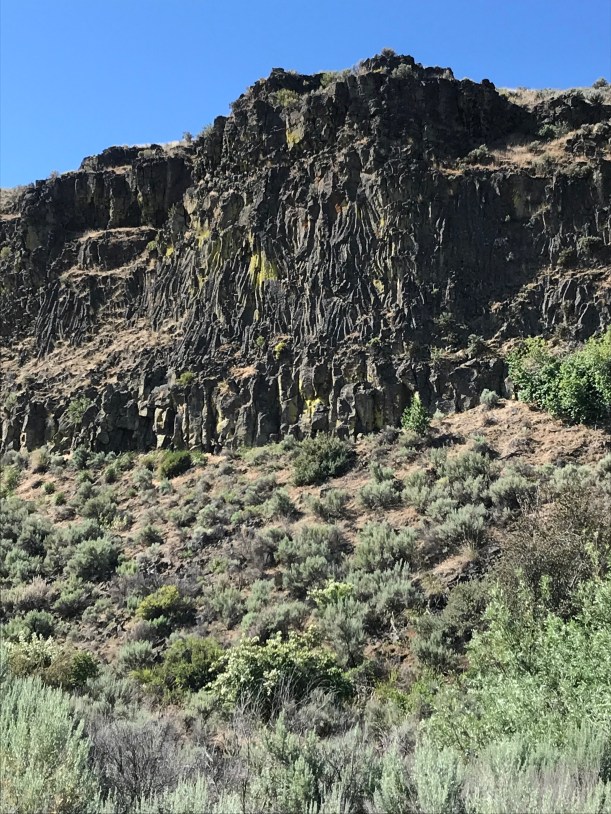
This is a local, easy hike with the hardest parts being concern for ticks, rattlesnakes, and heat. The views of the Selah Cliffs are gorgeous. As per signed instructions, we didn’t traipse off the path, which means we also didn’t see the basalt daisies for which the area is known. Judging by the trails leading up to the basalt cliffs, I’m sure some disregard rules. OR they could be game trails. Yes, I’ll go with that.
The hike/walk leads along a gravelled path for most of the distance. Towards the far end (headed east), hikers must go through a barbed-wire gate. After that, the gravel disappears and more clambering is required. During the entire hike east, we watched the Fred G. Redmon bridge loom ever larger and closer. Soon enough, we stood beneath the massive structure and listened to vehicles boom overhead. It was fascinating to look, listen, and call aloud. If you stand in just the right spot, your voice will echo back. I tried recording the echo, but there was too much interference.
We saw and heard a waterfall, but couldn’t get through the underbrush to get close. Plentiful birds, spiders, insects, lizards, and evidence of other wildlife kept us searching and entertained. The scenery was gorgeous, the basalt columns beautiful, and amazingly, the traffic overhead was negligible.
H is For Haiku is the lovely result of the imaginative, creative, and lyrical work of Sydell Rosenberg, mother of Amy Losak.
In honor of her mother, Amy Losak pursued the publication of her mother’s Haiku. Syd, one of the first members of the Haiku Society of America, dreamed of publishing a book for children focused on Haiku.
Haiku, a form of poetry, originated in Japan. Most readers recognize Haiku for the strict syllable count used for each of the three lines (most often 5-7-5) in a Haiku poem. Haiku is way to recognize the small things of nature and life-wonderful, amazing, poetic, and awe-inspiring.
“What’s most important about writing haiku is to focus on those many small moments we may overlook and make them special.” -Amy Losak
Beautifully illustrated, H is For Haiku brought a smile to my face with every new alphabet letter and corresponding Haiku. I enjoyed clever phrases, rich language, and observations of the natural life around us.
Well done, Sydell Rosenberg! Great job, Sawsan Chalabi! Amy Losak, I’m so glad you stuck with it and had H is For Haiku published. This book is a gift for us, if we but take the time to read and ponder.
KID KANDY:
Write Your Own Haiku Poem
1. Read H is for Haiku. Notice the clever words and illustrations. Both help tell the story of the Haiku.
2. Take a notepad and pencil outside. Spend time observing the nature around you. Focus on the small things you see. As you look, write down words that come to your mind. A parent or older sibling can help with this part.
3. Do you know what a syllable is? Clap your name. For me, I clap twice: An gie. 2 syllables. Practice with some other words.
4. Haiku is a poem with 3 lines. Each line has a certain syllable count: 5-7-5
5. Some people are not very strict with keeping the exact syllable counts, but it’s good practice as you learn the format for a Haiku poem.
6. Choose something you observed to be the subject of your Haiku. What do you want to say? Write down the words you want to use. Play with the words. Count out syllables. You can write ANYTHING you want in your Haiku poem.
7. Print your Haiku poem on clean paper. Add an illustration! Share it with a friend or family member! OR ME!!!
I won a copy of Nature’s Lullaby Fills the Night from KIDLIT411. Thanks, Sylvia and Elaine!
Nature’s Lullaby Fills the Night is the perfect bedtime – or anytime – read aloud! Peaceful rhyme tells the story of nature getting ready to go to sleep. Animals, plants, and other beauties prepare and nestle in for a good nights’ sleep. The illustrations, set in gorgeous deep blues and purples highlighted by nighttime light, perfectly match the winding down of the day.
I’ve totally enjoyed reading Nature’s Lullaby Fills the Night. Now, on to share it with the littles in my life. Thanks for the beautiful book, Dee and Bali!
KID KANDY:
Nighttime Painting
Materials: watercolor paints, brushes, water, crayons, heavy paper
1. Read Nature’s Lullaby Fills the Night. Notice the colors used in the illustrations. What’s your favorite page (animal, plant, setting)?
2. Use crayons to draw a nature picture. Include the moon and stars.
3. Paint over the drawing with darker colors like purple, blue, and black.