Each year on November 13, we celebrate World Kindness Day, “a day to celebrate and promote positive human interactions.” We focus on showing kindness in ways big and small. Every kindness extended to others spreads goodwill and lightens the load of stress people shoulder as they go about their days.
Need more info and ideas? I found Awareness Days very helpful. I especially like the list of ideas and the #hashtags to use when sharing and talking about World Kindness Day (and kindness in general).
Some things you could do include showing random acts of kindness, volunteering, donating to a charitable cause, and teaching kindness to children and young people.
Not quite two years old, my picture bookBe Kind, Make Friends, helps preschoolers and the younger audience learn about showing kindness and making friends. I’m glad to have this resource to encourage us to celebrate kindness every day! Do you know of any other resources to help promote kindness to the younger crowd? Add them to the comment section so we can all hear about them.
What will you do to celebrate World Kindness Day?
To celebrate World Kindness Day, I’m giving away one copy of Be Kind, Make Friends to someone who comments on this blog post (US only). Let us know how you would use Be Kind, Make Friends with someone in your world. Winner chosen in one week on November 20. Check back next Thursday to see who won!
Happy World Kindness Day! Thank you for being a part of this blog world!
Haiku means “light verse.” At its center, haiku are unrhymed three-line poems that focus on nature and are written in simple language. Follow this condensed checklist from How Do You Haiku? to make your haiku shine!
#1 Three Short lines: There are two ways of writing modern haiku. One way is to write haiku using a 5-7-5 pattern of counted syllables. That’s five syllables in the first line, seven in the second line, and five in the third line for a total of 17 syllables. That said, a haiku should take just “one breath” to read, so if counting syllables makes your haiku feel too long or “clumsy,” go ahead and write your poem with three short lines without counting syllables. In modern haiku, both styles are accepted.
#2 Imagery: Painting an image with words is essential for writing a good haiku. Imagery is a word or group of words that tap into the senses. Writing about what you can smell, hear, taste, see, or touch in nature will create strong images in your haiku.
#3 The Real Deal: Haiku is always happening around us. The trick is to pay attention and think deeply about what we see. When I say the real deal, I mean try writing from an actual experience. What you witness firsthand will give you details you couldn’t possibly imagine.
#4 Season Words: Haiku is about seasons, but the poet rarely mentions the season directly instead, they replaced the words winter, spring, summer, and fall with” kigo” (a season word). For example, when we read about tulips, we know it’s springtime without reading the word spring. Use season words whenever possible. I’ve included a template for a Saijiki (season word dictionary) below that you can download and complete to help you when writing haiku.
#5 Feeling: Haiku can make readers feel emotions like loneliness, grief, fear, or joy. The feeling is never said directly. Instead, the emotion is shown through the image the poet paints with words. Instead of writing “the sad dog,” you could write “lost puppy in a storm.” With these descriptive words, your reader can imagine the dog is cold, hungry, afraid, and, therefore, sad.
#6 Love of Nature: Haiku is a brief poem filled with compassion for nature. There is no room for hatred, violence, or cruelty.
#7 Ah! Moment: The best haiku ends in a way that surprises or enlightens your reader. The surprise makes us say, “Ah, I understand,” or “Ah, that’s funny.” The surprise comes at the end of the haiku as a subtle turn or change in the poem.
Now, as promised, here are some fun things you can do with haiku:
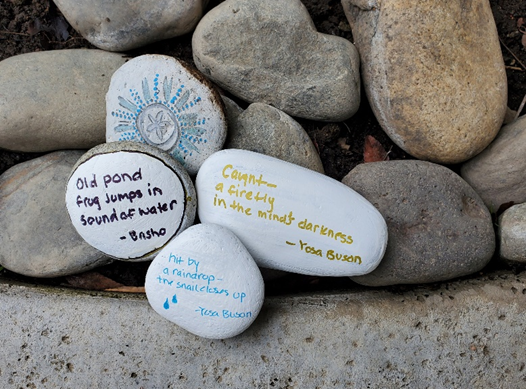
Carving a poem on a stone is an old Asian tradition. These stones are called kuhi (coo-hee) that are placed in gardens, parks, and temples.
Kuhi is a great writing activity for the whole family! Walk outside to find a smooth, flat stone, and try your hand at Kuhi! You can paint the rocks and add doodles or drawings if you’d like. Anything goes! Just have fun. Be sure to spray a couple of coats of clear sealing varnish when you are finished to protect your work from the outside elements. Create kuhi for your garden, for a friend, or leave one in a public park for someone to discover.
HAIKU COMICS:
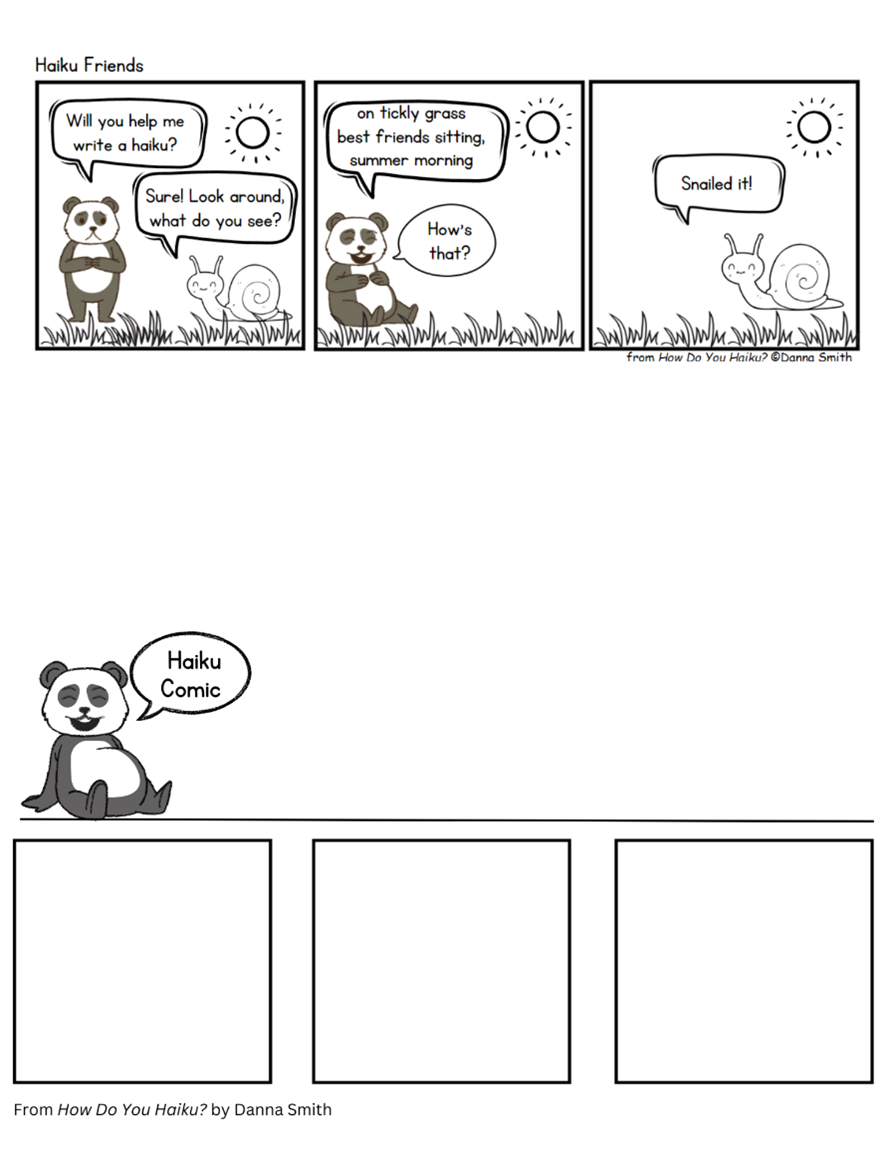
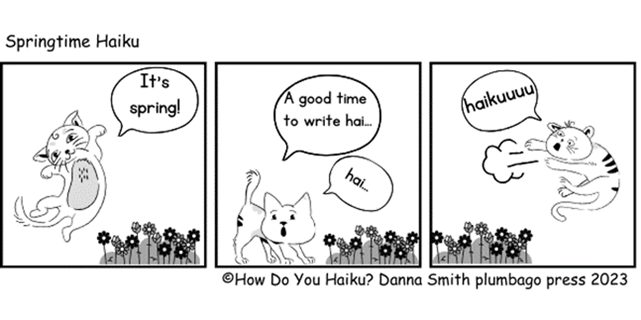
Comic strips offer a contemporary and creative way to celebrate haiku. Download this template with example and write your own haiku comic strip. Remember to use speech bubbles, thought bubbles, and sound words, like swish, pop, or splash.
DIGITAL HAIKU:
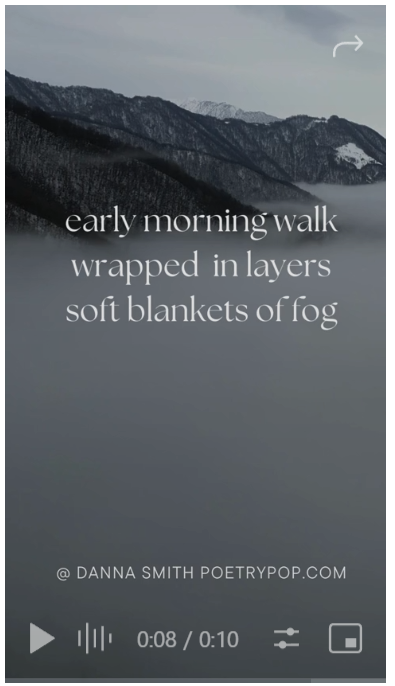
Showcase your haiku in a short video or graphic. Here’s an example of a haiku video I created in Canva, but you can use Google Slides, Word Swag, or another digital platform to make your digital haiku featuring your poem along with nature photos or videos. Post your graphics or video on your website or social media platforms to share your #haikumoments.
(Angie here. Sorry, but my blog does not allow videos. Please click the link below to go to Danna’s post on her blog to see her video. It’s super easy. Thank you!)
In tip #4 above, we talked about season words. Every country or region has its own weather and kigo. Download this template to create a Saijiki(season dictionary) for writing your haiku! Print four templates, one for each season.
ENTER GIVEAWAY
I am giving away two paperback Poetry Pop journals to one lucky winner (one of each color)! Use these journals to keep track of your #haikumoments or write along with poetry pop’s posts and challenges. To enter, just comment on this post. Angie will randomly choose a winner on August 21, 2024. If you’d like to purchase a hardcover or paperback Poetry Pop journal, you can do so here.
Thanks again, Angie. This was a blast!
Oh, and readers, did you know Angie contributed to the book How Do You Haiku? You can find her beautiful haiku on pages 36 and 57!
“A rumination on our interconnection with others” (Hunter Liguore)
The Whole World Inside Nan’s Soup
Written by Hunter Liguore
Illustrated by Vikki Zhang
Yeehoo Press, 2021
It’s World Read Aloud Day! Here’s one picture book that will make your read aloud time scrumptious.
We all know how a grandmother can make the world go round. I’m a Nana, and I join with Nan as she cares for her loved ones by feeding them. Not only is this a delicious story, but The Whole World Inside Nan’s Soup is filled cover to cover with delectable illustrations and tasty tidbits of all of the work involved in providing the ingredients and growing the soup. Lovely! Thanks so much to Kathy Temean, Hunter Liguore, Vikki Zhang, and Yeehoo Press for introducing me to The Whole World Inside Nan’s Soup.
I’m glad you stopped by. Keep reading to meet Hunter Liguore and learn about her picture book, The Whole World Inside Nan’s Soup. See the directions at the bottom of this post to find out how to get your name in the hat to win a copy.
***Coming soon: Swing back by to meet meet illustrator Vikki Zhang!
Now, let’s get to our interview with Hunter!
Welcome, Hunter! Congratulations on your new book! Tell us a little about The Whole World in Nan’s Soup.
The Whole World in Nan’s Soupis a rumination on our ability to recognize our interconnectedness with ‘all’ people. It is wisdom passed down many generations through my own gran, who understood that in order to eat a single meal, it takes the whole world to make it.
Our dinner table doesn’t end at the four corners, but is reciprocal; it extends to all those faceless helpers involved with making sure we’re nourished—and that’s a very beautiful thing! When we take the time—through slow-cooking—to see and talk about ‘all’ people in a bowl of soup, then we can begin to notice it in other areas of our life with the same care and unity.
The more we see our oneness, the more each meal—each bowl of soup—becomes a celebration, and our struggle with each other falls away, and the harmony we experience within will be reflected back.
I love how the interconnectedness plays out in this picture book. I have so many fond memories of eating meals prepared by my grandmothers and mother. Living in an agricultural valley, I see how much work it takes to feed families.
What was your inspiration for The Whole World Inside Nan’s Soup?
The inspiration for The Whole World in Nan’s Soup comes from a careful rumination on reciprocity, or the understanding that the food we eat each day is made possible through the dignity of gentle workers. Reciprocity is more than an intellectual understanding of treating others with the same respect we wish for ourselves. It goes deeper and implies, ‘Who I am on the inside is the same as what is on the inside of others,’—and if that’s true, we can experience and discover for ourselves the delicate thread that connects all people.
When we meet others, we can do so with an awareness that their suffering is our suffering, felt and experienced the same way, and through empathy—through not wanting suffering for ourselves—we will not want it for another; thus, we will seek harmony and peace in all our words, actions, and relationships.
This was the foundation of the story, which can be practiced while making soup! As our understanding of reciprocity grows, so does our empathy. The circle of life expands, as we recognize we’re not able to live without those beautiful helpers, which we can now honor with our thankfulness, our kindness, our understanding, our patience, and most of all, our self-responsibility that discerns: we are the root of others’ suffering when we set aside our interconnection. We can always take time to recognize our interconnection with others. Even in a bowl of soup!
Beautiful!
What was your journey for this book?
A very gentle one.
I love hearing that!
How did you celebrate the book birthday of THE WHOLE WORLD INSIDE NAN’S SOUP when it came out August 2021?
Making soup and sharing it with family and friends.
Perfect!
I love the heart in THE WHOLE WORLD INSIDE NAN’S SOUP. The family relationships and the connections between ingredients and their sources is fascinating. It takes making soup to a deeper level. How do imagination and your childhood experiences impact your creativity as you work on picture books?
For me, writing evolves from our wholeness with our self/others/world, a harmonized unity or intuition. It is a way of life, a practice that is occurring in each delicate moment, a sacred unfolding, one where I’m given an opportunity to bring gentle love, unity, cooperation, and perfection into my craft and art, creating for the sake of creating, while being in tune with the greater whole.
Creativity is such a gift.
What are you working on now?
A vision of our future that includes a human traffic free food chain through a farm-certification program similar to Fair Trade or organic.
That sounds fascinating!
What tip would you give to a new picture book author or illustrator?
To all writers/creatives, trust yourself. Writing will only ever be about how much someone is willing to trust their vision. We are inventor of worlds, with words, it’s an art entrusted to the one who perseveres even in doubt, even when nothing makes sense, in order to realize the creative vision as a reality—and that takes trust! It takes belief that uncertainty isn’t difficulty, but an opportunity to shape the creative fire.
Thank you for the encouragement!
Surprise us! What else would you like to share?
The Whole World in Nan’s Soup is a celebration of our interconnection to our world, so I encourage readers to find ways to celebrate life, food, family/friends, our ancestors and relationships, our Earth and the wild ones dwelling in partnership with us; our meals, our dinner table, gentle cooking without harm; celebrate our farms and the food stores you patron, and the people you meet there, who are caring for you. Plant flowers and watch the cycle of this infinite celebration of love and life. Be attentive and you’ll see how connected we truly are. Even in difficulty, we can find small ways to celebrate and contribute to the joy in the world.
Thank you, Hunter, for sharing from your heart. Thank you for visiting today and for creating this beautiful picture book!
Ready to find out how to get your name in the hat to win a copy of The Whole World Inside Nan’s Soup (US only)? A winner will be randomly chosen in one week on Wednesday, February 9.
1. Like and comment on this blog post. Please make sure I have your email address so I can notify you if you win. Example: bookwinner (at) yahoo (dot) com
2. Follow this blog and tell me how you follow. Please make sure I have your email address so I can notify you if you win.
About me: Hunter Liguore is a gentle advocate for living in harmony with the natural world and with one another. An award-winning author, professor, and historian, her writing has appeared internationally in magazines like Spirituality & Health, Irish Pages, Orion, and more. When not making soup, she is often roaming old ruins, hillsides, and cemeteries. To learn more, visit: hunterliguore.org or @skytale_writer.







 Love, Laughter, and Life