This adorable board book is just perfect for Thanksgiving AND any other day of the year when we want to express thanks to someone we meet. As you can tell by the cover, this is not a Thanksgiving book, yet I can see how fun it would be to share it with little readers to give them ideas of how to tell (and show) others thank you. As far as the rest of the year, The Thank You Book is just right.
Colorful illustrations and simple text come together in a delightful package. The rhymes roll easily off the tongue, making it fun to read aloud. From the back cover:
Thanking is easy. Thanking is fun. Can you find a way to thank someone? This lovely book shows us all the ways we can be thankful!
I love how we read about not only ways to say thank you with words, but ways to say (and show) thanks in other ways.
So to you, my readers, thank you for stopping by today! I appreciate you!!
This adorable board book has it all: board book quality, gorgeous illustrations, perfect little nature-based haiku poems, lift-the-flaps (always a favorite with the young crowd), hide-and-seek animals. PEEK-BOO-HAIKU is written across the seasons, so add that to its charm and discussion possibilities.
I love to write haiku, and Danna is one of the best haiku writers I’ve had to pleasure to interact with. I’ve admired many of her books. PEEK-A-BOO HAIKU is now one of my mentor texts.
PEEK-A-BOO HAIKU will make a wonderful gift for my almost 11-month-old granddaughter. IF I can give it away. Or maybe she gets her own copy.
Thank you, Danna Smith, for sharing all about haiku last week in a very special blog post. You can read it here. Danna has offered a giveaway of 2 (TWO!) of her Poetry Pop Journals! Wow!
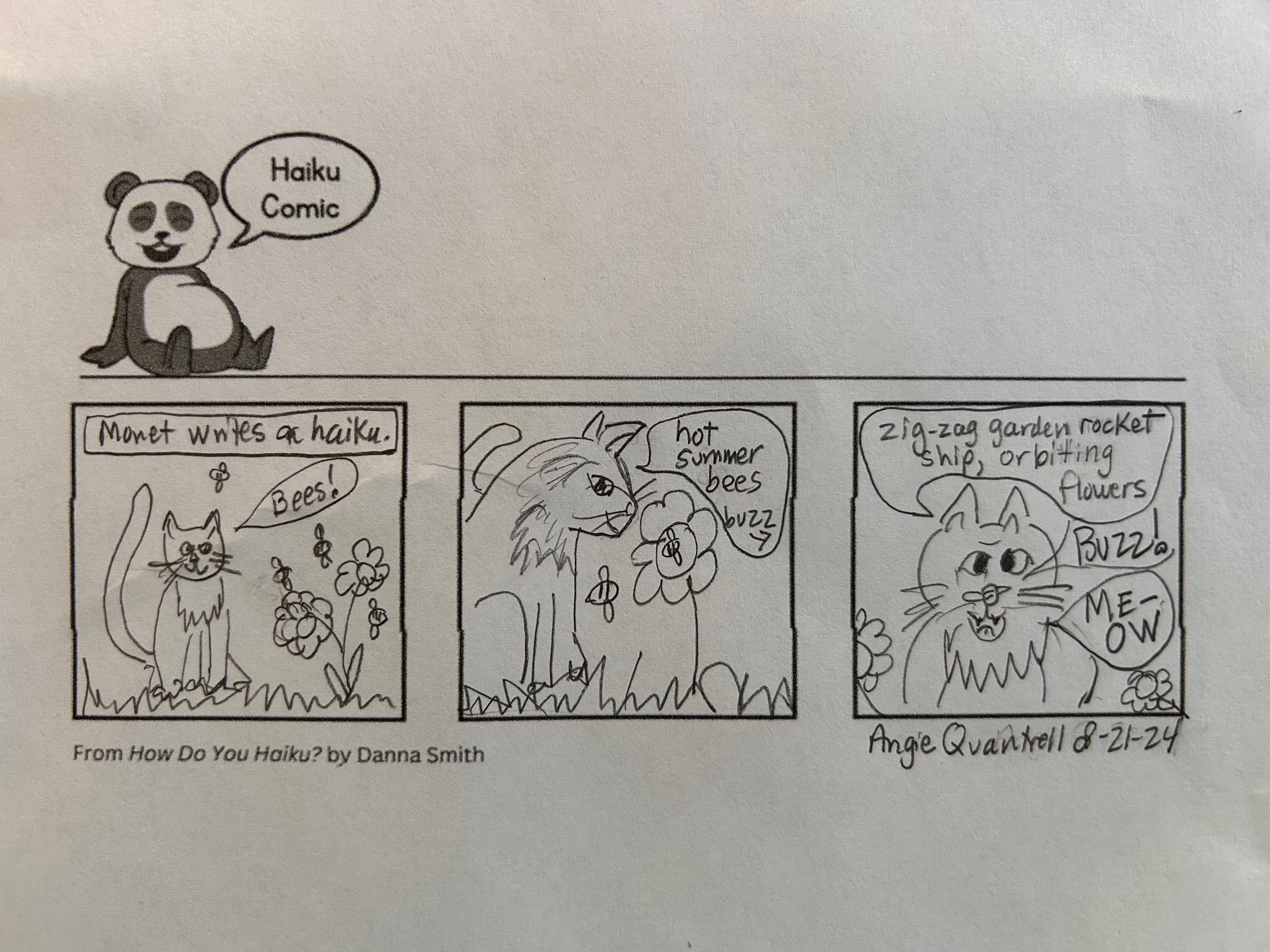
But first. I had to play. I used the template Danna shared and penned a haiku comic. Sadly, you have to use your imagination to understand the drawings, and it was much harder to print small words than it looks! This is Monet, our cat. She loves the garden and watching moving things. I assure you, she is much prettier in real life.
In case you can’t read the print, here is my haiku comic:
Monet writes a haiku.
hot summer bees buzz
zig-zag garden rocket ships
orbiting flowers
Now that was fun! We would LOVE to read your haiku! Post one in the comments or tag us with #haikumoment so we can find you!
Drum roll, please.
The winner (with assistant Monet) of the Poetry Pop journals is:
It got a little dicey after this, because then Monet wanted to play a paper game.
Alyson, come on down! You are the winner of 2 Poetry Pop journals!
Thanks, everyone, for reading and participating in the fun. And thank you, Danna, for the word play fun and inspiration!
Haiku means “light verse.” At its center, haiku are unrhymed three-line poems that focus on nature and are written in simple language. Follow this condensed checklist from How Do You Haiku? to make your haiku shine!
#1 Three Short lines: There are two ways of writing modern haiku. One way is to write haiku using a 5-7-5 pattern of counted syllables. That’s five syllables in the first line, seven in the second line, and five in the third line for a total of 17 syllables. That said, a haiku should take just “one breath” to read, so if counting syllables makes your haiku feel too long or “clumsy,” go ahead and write your poem with three short lines without counting syllables. In modern haiku, both styles are accepted.
#2 Imagery: Painting an image with words is essential for writing a good haiku. Imagery is a word or group of words that tap into the senses. Writing about what you can smell, hear, taste, see, or touch in nature will create strong images in your haiku.
#3 The Real Deal: Haiku is always happening around us. The trick is to pay attention and think deeply about what we see. When I say the real deal, I mean try writing from an actual experience. What you witness firsthand will give you details you couldn’t possibly imagine.
#4 Season Words: Haiku is about seasons, but the poet rarely mentions the season directly instead, they replaced the words winter, spring, summer, and fall with” kigo” (a season word). For example, when we read about tulips, we know it’s springtime without reading the word spring. Use season words whenever possible. I’ve included a template for a Saijiki (season word dictionary) below that you can download and complete to help you when writing haiku.
#5 Feeling: Haiku can make readers feel emotions like loneliness, grief, fear, or joy. The feeling is never said directly. Instead, the emotion is shown through the image the poet paints with words. Instead of writing “the sad dog,” you could write “lost puppy in a storm.” With these descriptive words, your reader can imagine the dog is cold, hungry, afraid, and, therefore, sad.
#6 Love of Nature: Haiku is a brief poem filled with compassion for nature. There is no room for hatred, violence, or cruelty.
#7 Ah! Moment: The best haiku ends in a way that surprises or enlightens your reader. The surprise makes us say, “Ah, I understand,” or “Ah, that’s funny.” The surprise comes at the end of the haiku as a subtle turn or change in the poem.
Now, as promised, here are some fun things you can do with haiku:
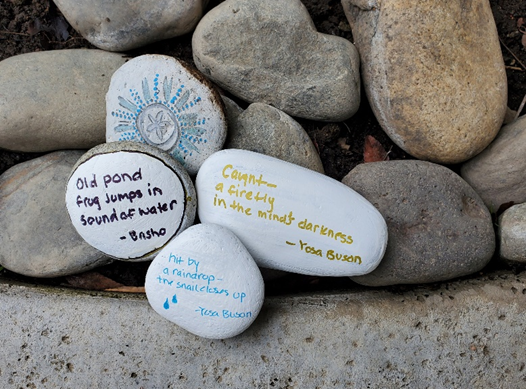
Carving a poem on a stone is an old Asian tradition. These stones are called kuhi (coo-hee) that are placed in gardens, parks, and temples.
Kuhi is a great writing activity for the whole family! Walk outside to find a smooth, flat stone, and try your hand at Kuhi! You can paint the rocks and add doodles or drawings if you’d like. Anything goes! Just have fun. Be sure to spray a couple of coats of clear sealing varnish when you are finished to protect your work from the outside elements. Create kuhi for your garden, for a friend, or leave one in a public park for someone to discover.
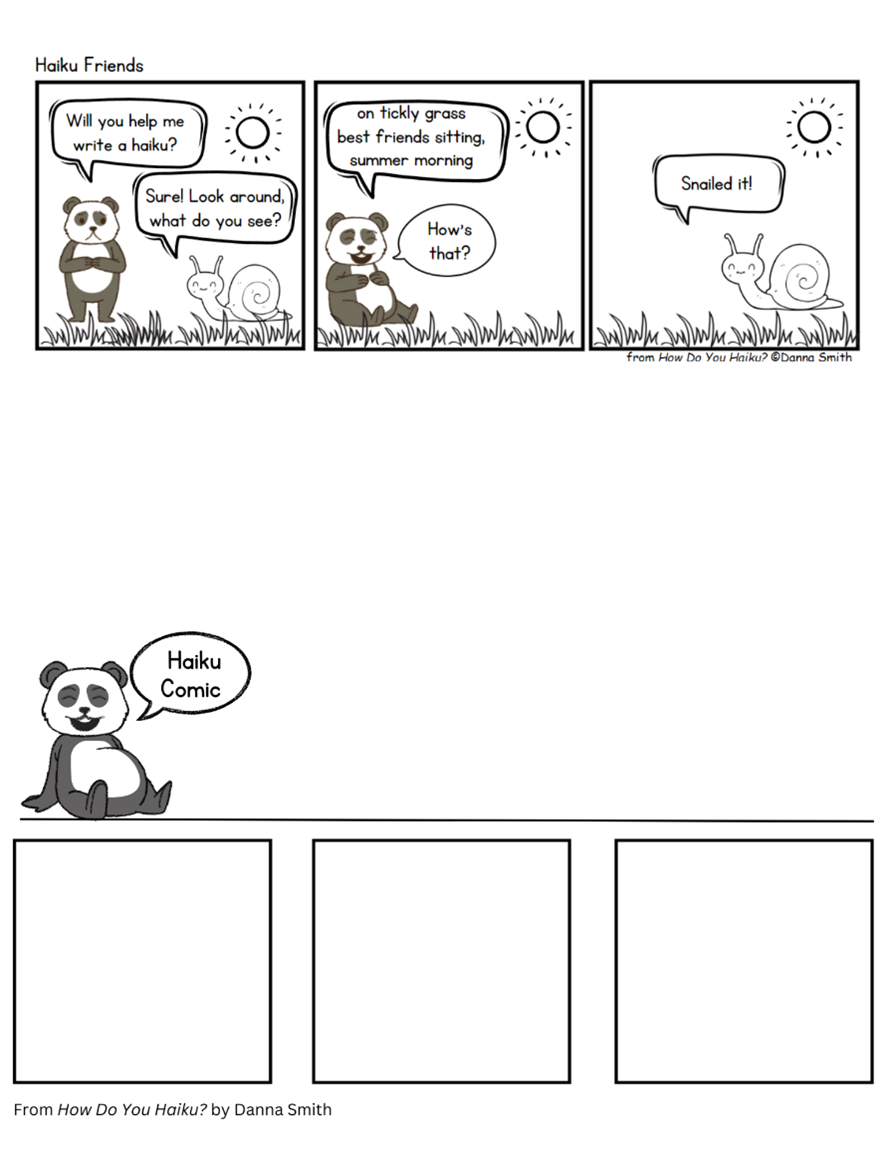
HAIKU COMICS:
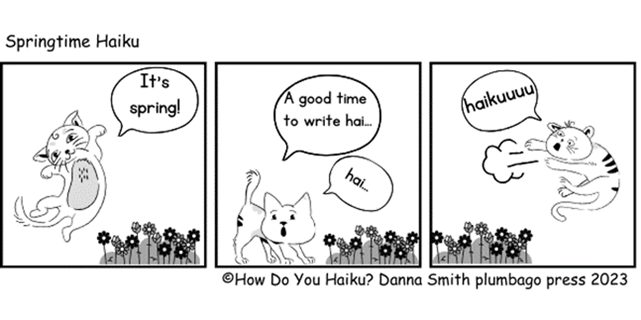
Comic strips offer a contemporary and creative way to celebrate haiku. Download this template with example and write your own haiku comic strip. Remember to use speech bubbles, thought bubbles, and sound words, like swish, pop, or splash.
DIGITAL HAIKU:
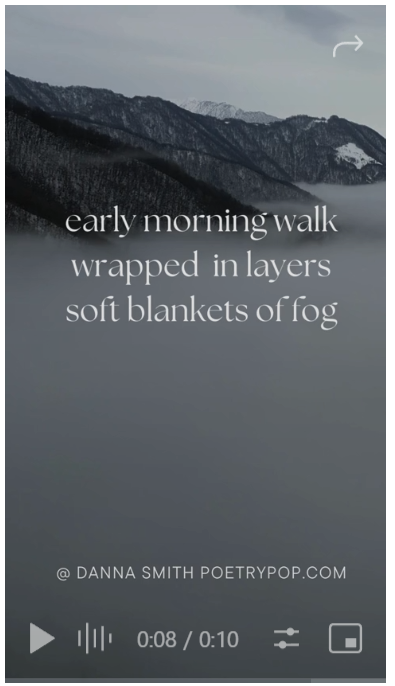
Showcase your haiku in a short video or graphic. Here’s an example of a haiku video I created in Canva, but you can use Google Slides, Word Swag, or another digital platform to make your digital haiku featuring your poem along with nature photos or videos. Post your graphics or video on your website or social media platforms to share your #haikumoments.
(Angie here. Sorry, but my blog does not allow videos. Please click the link below to go to Danna’s post on her blog to see her video. It’s super easy. Thank you!)
In tip #4 above, we talked about season words. Every country or region has its own weather and kigo. Download this template to create a Saijiki(season dictionary) for writing your haiku! Print four templates, one for each season.
ENTER GIVEAWAY
I am giving away two paperback Poetry Pop journals to one lucky winner (one of each color)! Use these journals to keep track of your #haikumoments or write along with poetry pop’s posts and challenges. To enter, just comment on this post. Angie will randomly choose a winner on August 21, 2024. If you’d like to purchase a hardcover or paperback Poetry Pop journal, you can do so here.
Thanks again, Angie. This was a blast!
Oh, and readers, did you know Angie contributed to the book How Do You Haiku? You can find her beautiful haiku on pages 36 and 57!
How Do You Haiku? A Step-by-Step Guide with Templates
by Danna Smith
Plumbago Press, 2023
I’m jiggling in my seat with joy! How Do You Haiku? A Step-by-Step Guide with Templates by Danna Smith is out in the world! I love snapping photos and writing haiku poems to go with them, so imagine my excitement when Danna invited me to contribute to her haiku project! What an honor!
Danna is swinging by the blog today to tell us a little more about her newest book. She has graciously shared some of the pages in her book. Let’s get to it.
Welcome, Danna! I’m so glad you are stopping by today to visit. Tell us about yourself.
Thank you, Angie, I’m happy to be here. I grew up in Salt Lake City, Utah but have lived in northern California for the past 22 years. My children are grown, and my husband and I are expecting our first grandchild soon! Writing for children is more than my career—it’s my passion. I am so fortunate to wake up and able to work at my dream job every day. In my spare time I love walking nature trails, reading, gardening, and doing yoga.
A first grandchild, how exciting! Congratulations for the new baby-on-the-way AND your newest book! I’d love to live close enough to walk those nature trails with you and share grandbaby stories.
How long have you been writing poetry? When did you become interested in haiku?
I’ve loved words and wordplay for as long as I can remember. I wrote my first poem when I was eight years old and haven’t stopped since. I was introduced to Haiku in elementary school. The idea of observing nature through poetry appealed to me. And counting syllables felt like a word game! Today, I fill my haiku journal with haibun (haiku with story) and hagia (haiku with art) too!
I love this! Nature is amazing! And you are right, syllable counting is like a game. I LOVE wordplay.
Congratulations on the release of your new book How Do You Haiku? A Step-by-Step Guide with Templates! What inspired you to write this book?
Thank you! I’m very excited for its release! I wanted to write a book that I would have loved to read when I was a child. One that explained how to write haiku in simple steps and gave me ways to celebrate my work. The book is loaded with fun activities like how to write haiku comics, a poetry-on-the-go travel game, and templates to use when sharing poems with others.
This is a great resource for writers! I imagine teachers will be able to use it as well when they are teaching students about writing haiku.
The reading age for How Do You Haiku? A Step-by-Step Guide with Templates is listed at 8-12 years, but as a 60-ish writer, I cannot wait to read and apply the information in this guide. How did you decide on this age range?
I agree! It’s really a book for readers ages 8 & up. Poets of all levels will enjoy it whether they are just starting to write haiku or want to refresh their knowledge. The age range listed for the book is simply a technicality on the publishing side of things.
That’s good to know. Not that a listed age range has ever stopped me from using the books I want to use! LOL.
As the sole creator of your new book, what were some of the tasks you needed to complete?
This book was such a pleasure to write. There were a few must haves for me:
Haiku is one of the oldest poetry forms and the rules can get quite complicated. With that in mind, my main goal was to teach haiku to my readers in its simplest form so it wouldn’t feel overwhelming.
It had to be fun! I wanted to pack this little handbook full of lots of activities and templates that would appeal to a wide range of readers to get them excited about reading and writing poetry.
I wanted to encourage my readers to share their work with others, which can be scary for some.
I also wanted to share a bit of haiku history by including quotes and short biographies of four of the great haiku masters.
It was my goal to make this book part instruction, part pep-talk, and a whole lot of wordplay.
Your book covers all of the haiku bases. I just received my copy and I look forward to reading your haiku poems, reading from the haiku masters, reading haiku by a variety of writers, and then practicing by writing new haiku. What a great resource! It’s the perfect introduction to haiku.
I was honored to contribute two haiku poems and one photo to your book. Why did you decide to include the work of other contributors? How did that choice change how you wrote and compiled the book?
First, I want to thank you and the other poets and children’s book authors for contributing your amazing poetry and photos to the making of this book! I could not have done it without you all!
I chose to include the work of other poets to make the book more interesting and fulfilling. There are many books with the master’s poetry and there are a few books with my poetry, but I imagined combining the three would give my readers a variety of poetry and an experience that they couldn’t get anywhere else.
Since the book included contributing poet’s work, the pressure was on! I wanted contributors to love the book as much as I do. I wanted them to be proud to have their names on the cover and their poetry tucked inside.
Well done! Your plan worked very well. I am thrilled with the book!
I wrote my first picture book in a high school creative writing class and loved the process. It was then that I vowed to work hard at becoming a published picture book author one day. I published my first picture book in 2004 with Disney-Hyperion and have gone on to author many more. Then the board book bug hit me 😊. I wrote my first board book, Wake Up, Freight Train! and it was such fun! I love that I get to be a part of introducing the littlest readers to books for the first time! My fourth and fifth board book will be published in 2025.
You could say I became a novelist by accident. One day I took a DNA test and learned that the man who raised me was not my biological father. The foundation I built my life around had crumbled. As I always do, I started writing poetry for therapy. After I wrote about 12 poems, I showed them to my agent with the idea of writing a novel in verse based on my DNA discovery. She was on board and two years later the book was published. The Complete Book of Aspen is a novel in verse (ages 14 & up), that delves into the emotional journey of a 15-year-old girl named Aspen as she discovers a long-kept family secret that challenges her identity.
Wonderful! I love hearing about your different books.
What are you working on now (if you can tell us)? Any surprises coming up?
I have five new books releasing in 2024-2026 including a couple more Little Golden Books. In the meantime, I am working on a big picture book project that I’m very excited about. It hasn’t been officially announced yet so mums the word for now. I’m also working on a few new board books that I hope my publisher will love.
Congratulations! It’s going to be a couple of exciting years for you!
Thank you so much for stopping by today, Danna. Best wishes to you as you continue to dream up new projects!
Thank you again for having me! It’s been a pleasure.
How Do You Haiku?: A Step-by-Step Guide with Templates
Written by Danna Smith
Plumbago Press
September 1, 2023
Happy book birthday to How Do You Haiku?: A Step-by-Step Guide with Templates! Congratulations, Danna! I’m so excited to read this book.
Not only because I was one of the contributors (I am truly honored to included) . . .
(the following list is taken from Danna’s book page on Amazon)
Contributing Poets
Includes haiku by contributing poets Kate Coombs, Nancy Etchemendy, Matt Forrest Esenwine, Raven Howell, Linda Hoffman Kimball, Amy Losak, Bobi Martin, Angie Quantrell, Sydell Rosenberg, Lee Wardlaw, and Linda Whalen.
but because I LOVE haiku. I love writing haiku, being outside in nature, finding amazing natural wonders, taking photos, and coming back home to pen haiku about my discoveries.
PLUS. This is a how-to book. With templates. Whoohoo! What a great resource!
Amazon Blurb:
An excellent resource for at home or in the classroom
From the author of Peek-A-Boo Haiku (Simon & Schuster) comes a haiku how-to handbook. Haiku is a Japanese poetry form, but it’s more than just a short, three-line poem. It’s an opportunity to slow down, go outside, and experience the world in a new way. Haiku is a “snapshot” of a moment in nature (if you blink, you might miss it!), and it’s a powerful way to show compassion for all living things.
This book will help you understand haiku so you can create poems with powerful words and images. Each chapter contains examples from Japanese haiku masters and current poets. The included activities and templates will guide you through fun ways to “haiku,” including painting poem stones for your garden (Kuhi), creating haiku comic strips, and writing group poems with your friends (Renga). How Do You Haiku? This handbook will show you how— step-by-step.
Congratulations, Danna!
Danna Smith
Danna Smith is a poet and award-winning author of over twenty-five books for children.
When she was young, a pencil was her favorite toy. She grew up weaving words into silly poems or stories that sparked emotion. She wrote her first poem when she was eight, her first short story when she was ten, and her first picture book draft when she was seventeen.
Born and raised in Salt Lake City, Utah, she currently lives and creates in beautiful northern California wine country.
Choo-choo! Hop aboard this hard-working nighttime freight train!
Written by Danna Smith and illustrated by Jon Andersen, this sturdy board book will delight train lovers of all ages. 🙂
Thank you, Danna Smith, Lynne Marie, and Rate Your Story March on with Mentor Texts! After participating each day, reading posts, commenting, and reading/studying mentor texts (picture books worth a closer read), everyone was eligible for prizes offered by blog guests. Fortunately for me, my name was pulled and I won a copy of Danna Smith’s adorable board book Wake Up, Freight Train!
Thank you to everyone for a fantastic month of reading, studying, and learning!
Why I Love This Book:
~ adorable!
~ fun, rhyming text
~ trains, an ever popular subject matter for young readers
~ word play and train-specific words
~ answers to “What does a freight train do at night?”
~ bright colors, animals and wildlife, shaped board book
~ plenty of onomatopoeia so readers can join in the fun!
Hop aboard this train-shaped board book that introduces each car of a freight train during a nighttime adventure!
Blow the train whistle, shovel more coal. Here we go, freight train! Get ready to roll! Toot-toot goes the horn, Blink-blink go the lights, Clang-clang goes the bell, all through the night.
Featuring all the cars of a freight train, this board book is perfect for young readers who love trains! And since freight trains ride at night, there are adorable sleepy animals throughout for little ones to find.









 Love, Laughter, and Life