orange on green surprise
heart shows garden trick, fall joy
love me some pumpkins
pumpkin heart by Angie Quantrell
Yakima Valley

orange on green surprise
heart shows garden trick, fall joy
love me some pumpkins
pumpkin heart by Angie Quantrell
Yakima Valley

Welcome, Danna! Dear readers, Danna is here to share more about haiku! I’m so excited to learn more about haiku wiht all of you! Take it away, Danna!
I want to thank Angie for the opportunity to hop over to her blog to celebrate haiku with you!
But first, SURPRISE, it’s time for a pop quiz! (Hey, it’s okay. I promise you’ll ace it!).
Question: What can you do with haiku?
A) Two, write it and read it
B) Three, write it, read it, and share it
C) Is there more? Do tell!
Answer: C! There is so much more you, your family, and students can do with haiku. In my book, How Do You Haiku? A Step-by-Step Guide with Templates, I introduce various haiku activities and crafts for all ages.
I’ll share some ideas with you below, but before we get started, let’s talk about haiku for those who are just getting started or want a refresher.
WHAT HAIKU REALLY WANTS

Haiku means “light verse.” At its center, haiku are unrhymed three-line poems that focus on nature and are written in simple language. Follow this condensed checklist from How Do You Haiku? to make your haiku shine!
#1 Three Short lines: There are two ways of writing modern haiku. One way is to write haiku using a 5-7-5 pattern of counted syllables. That’s five syllables in the first line, seven in the second line, and five in the third line for a total of 17 syllables. That said, a haiku should take just “one breath” to read, so if counting syllables makes your haiku feel too long or “clumsy,” go ahead and write your poem with three short lines without counting syllables. In modern haiku, both styles are accepted.
#2 Imagery: Painting an image with words is essential for writing a good haiku. Imagery is a word or group of words that tap into the senses. Writing about what you can smell, hear, taste, see, or touch in nature will create strong images in your haiku.
#3 The Real Deal: Haiku is always happening around us. The trick is to pay attention and think deeply about what we see. When I say the real deal, I mean try writing from an actual experience. What you witness firsthand will give you details you couldn’t possibly imagine.
#4 Season Words: Haiku is about seasons, but the poet rarely mentions the season directly instead, they replaced the words winter, spring, summer, and fall with” kigo” (a season word). For example, when we read about tulips, we know it’s springtime without reading the word spring. Use season words whenever possible. I’ve included a template for a Saijiki (season word dictionary) below that you can download and complete to help you when writing haiku.
#5 Feeling: Haiku can make readers feel emotions like loneliness, grief, fear, or joy. The feeling is never said directly. Instead, the emotion is shown through the image the poet paints with words. Instead of writing “the sad dog,” you could write “lost puppy in a storm.” With these descriptive words, your reader can imagine the dog is cold, hungry, afraid, and, therefore, sad.
#6 Love of Nature: Haiku is a brief poem filled with compassion for nature. There is no room for hatred, violence, or cruelty.
#7 Ah! Moment: The best haiku ends in a way that surprises or enlightens your reader. The surprise makes us say, “Ah, I understand,” or “Ah, that’s funny.” The surprise comes at the end of the haiku as a subtle turn or change in the poem.
Now, as promised, here are some fun things you can do with haiku:
KUHI: POEM STONES
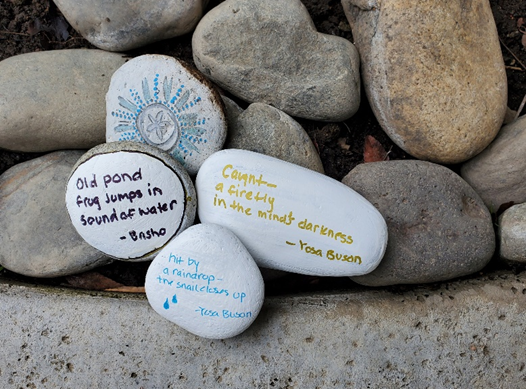
Kuhi ©Danna Smith at poetrypop.com
Carving a poem on a stone is an old Asian tradition. These stones are called kuhi (coo-hee) that are placed in gardens, parks, and temples.
Kuhi is a great writing activity for the whole family! Walk outside to find a smooth, flat stone, and try your hand at Kuhi! You can paint the rocks and add doodles or drawings if you’d like. Anything goes! Just have fun. Be sure to spray a couple of coats of clear sealing varnish when you are finished to protect your work from the outside elements. Create kuhi for your garden, for a friend, or leave one in a public park for someone to discover.
HAIKU COMICS:
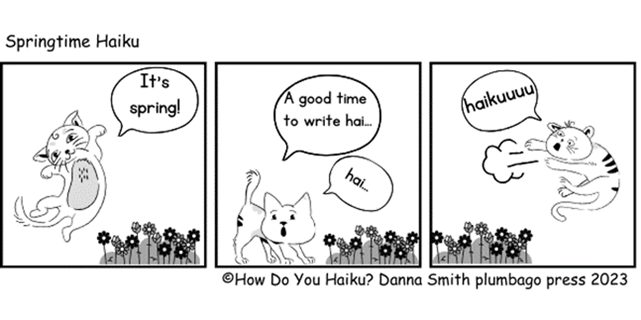
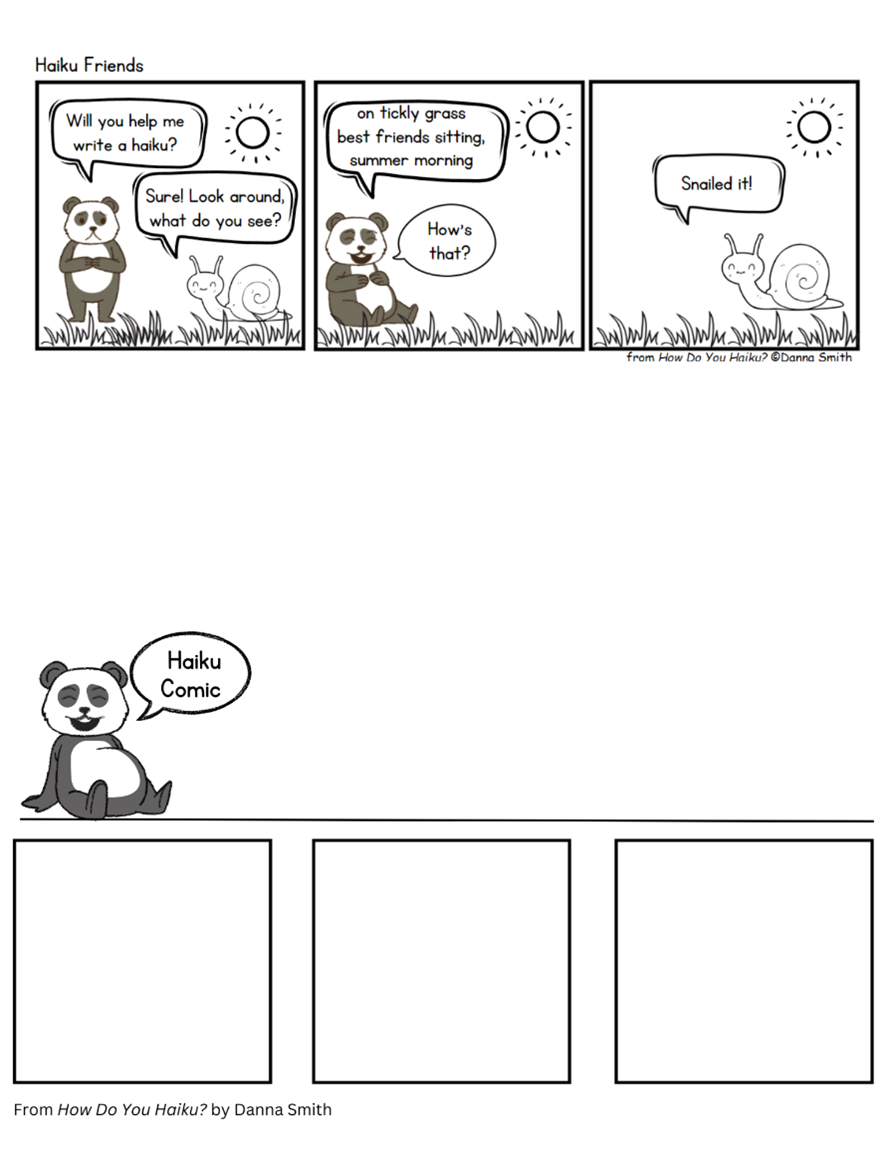
Comic strips offer a contemporary and creative way to celebrate haiku. Download this template with example and write your own haiku comic strip. Remember to use speech bubbles, thought bubbles, and sound words, like swish, pop, or splash.
DIGITAL HAIKU:
Showcase your haiku in a short video or graphic. Here’s an example of a haiku video I created in Canva, but you can use Google Slides, Word Swag, or another digital platform to make your digital haiku featuring your poem along with nature photos or videos. Post your graphics or video on your website or social media platforms to share your #haikumoments.

(Angie here. Sorry, but my blog does not allow videos. Please click the link below to go to Danna’s post on her blog to see her video. It’s super easy. Thank you!)
BONUS DOWNLOAD
In tip #4 above, we talked about season words. Every country or region has its own weather and kigo. Download this template to create a Saijiki (season dictionary) for writing your haiku! Print four templates, one for each season.
ENTER GIVEAWAY

I am giving away two paperback Poetry Pop journals to one lucky winner (one of each color)! Use these journals to keep track of your #haikumoments or write along with poetry pop’s posts and challenges. To enter, just comment on this post. Angie will randomly choose a winner on August 21, 2024. If you’d like to purchase a hardcover or paperback Poetry Pop journal, you can do so here.
Thanks again, Angie. This was a blast!

Oh, and readers, did you know Angie contributed to the book How Do You Haiku? You can find her beautiful haiku on pages 36 and 57!
Happy Writing!
Danna Smith
DANNA! This has been awesome! I can’t wait to go write haiku and play with words! Thank you so much for stopping by and sharing!
Readers, make sure to comment below to get your name in the hat for a chance to win two Poetry Pop journals! We’d love to read your #haikumoment!
 Love, Laughter, and Life