
What to do when there is only 1 child?
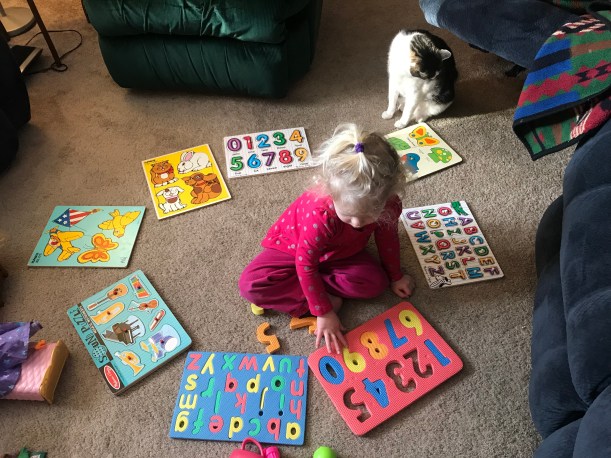
Make a puzzle circle! Miss Autumn (2) was quite content to sit inside the puzzle circle and work puzzles. Simone was happy to supervise. A cozy nearby fireplace added ambiance and warmth for this cold winter day activity.
There is something about the NEST format of play. Are you a nest person? I am. I’ve always loved playing inside a circle formed by things-toys, books, supplies, whatever I’m working on-spread in a circle which surrounds me.
I really need to research this nest phenomenon. Does it point to a specific need, like security? Is nesting organizational in nature? Am I completely OCD and this is how it manifested itself when I was a child? Am I a circle person? Is this a form of marking my territory, albeit the creation of play boundaries and personal space instead of doggy pee trails? What does that mean?
Not nesting, as in I’m pregnant and preparing for the imminent birth of my child, though I also experienced that type of nesting. I clearly remember nesting the entire Memorial Day weekend. I thought I was just making things tidy, cleaning house, and putting baby things away. Lo and behold, our first baby came 3 weeks early and arrived before lunch on the Tuesday after Memorial Day. Surprise! I was baby nesting.
There is also the type of nesting performed by birds. I am not a bird. But I am amazed at the intricate, sturdy, vastly creative and unique types of nests these little bird brains build. With that in mind, I’m sure bird brain is a complement.
Back to play nesting. I have memories of Barbie nests, toy box nests (where the toy box is empty and I am surrounded by the toys), and fabric nests. The fabric nests lets you know this nesting trait carried over to my adult years. I remember a specific photo of my two preschoolers, complete with a circle of toys and nearly empty toy box. Donavyn and Autumn (grands) love sitting inside blanket nests. Is nesting hereditary?
Any ideas? Do you nest? Have you seen young children exhibit nesting? I’d love to know more about the nesting syndrome.


 Love, Laughter, and Life